
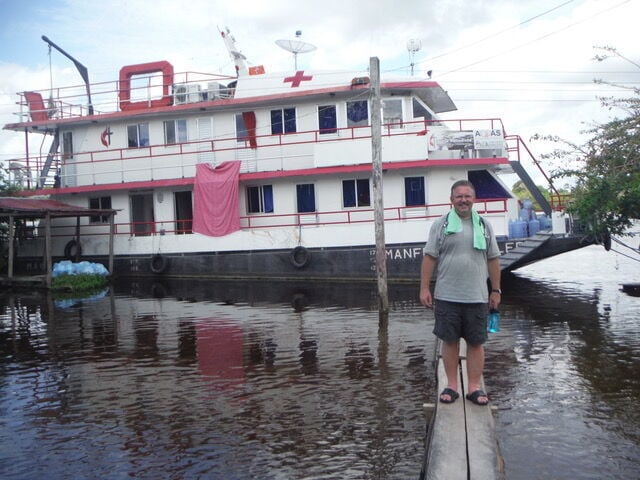
Infectious disease doctor Don Skillman, M.D., visits the military vessel he lived on while stationed in Brazil in 1980
Five hunters emerged separately from the Montana woods over a one-week period — all experiencing the same muscle pains, high fevers and elevated liver enzyme levels.
An infectious disease doctor in the Army for nearly 30 years and with St. Peter’s Health before retiring in 2018, Don Skillman, M.D., knew immediately what was ailing them. Leptospirosis, a rare jungle bacterial disease often spread through contact with contaminated soil or water, is, for the most part, treatable. But left on its own, it can be fatal. The hunters, it turned out, had consumed melted snow contaminated with rodent droppings.
“I treated people with this in Brazil,” Skillman said. “It had never been reported in Montana before, so everyone thought I was crazy when I first diagnosed it. You learn about it in med school, but then most everybody kind of forgets about it because it’s something you never see, unless you’re working in the tropics.”
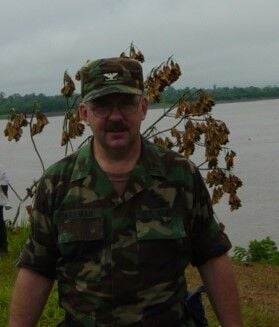
Skillman posing for a photo in Peru, circa 2004
And Skillman has definitely done his time in the tropics.
As a military doctor, he spent time researching bacteria, viruses, parasites and fungi from all over the world during multiple stints in Brazil, Africa, Thailand, Guam, Saipan and many other exotic places.
He spent so much time in Brazil he even became fluent in Portuguese. He estimates he has spent at least three years in Brazil, including weeks at a time traveling by boat up and down the Rio Negro, the largest tributary of the Amazon River, administering vaccines and providing healthcare to the locals.
“I always wanted to be the guy who people came to when they came out of the jungle with a fever,” he said. “Wild tropical places are staggeringly beautiful. The caterpillars, the fish, parrots, a few big snakes, jaguars — it’s an adventure every day. In the jungle, you are not at the top of the food chain and that certainly makes life more interesting.”
The native Montanan received his medical degree from the Uniformed Services University of Health Sciences F. Edward Hebert School of Medicine, the country’s leading federal health professions academy in Bethesda, Maryland.
Akin to the undergraduate programs of the U.S. military academies at West Point, Annapolis and Colorado Springs, USU provides free tuition. Students repay the country for their education through service.
“USU is a regular medical school, only you are in uniform, undergo military training and have additional courses with more of a military slant to them,” he said. “We have classes in cold weather, high altitude and underwater medicine, as well as aerospace evacuation from a battlefield, for example.”
Throughout his decades in the Army, Skillman trained and worked at hospital bases worldwide including Tripler Army Medical Center in Hawaii, SHAPE NATO’s military headquarters in Belgium, William Beaumont Army Medical Center in El Paso, Texas, and Fitzsimons Army Medical Center in Aurora, Colorado, among many others. He also spent three years on a fellowship working on infectious diseases at Walter Reed National Military Medical Center.
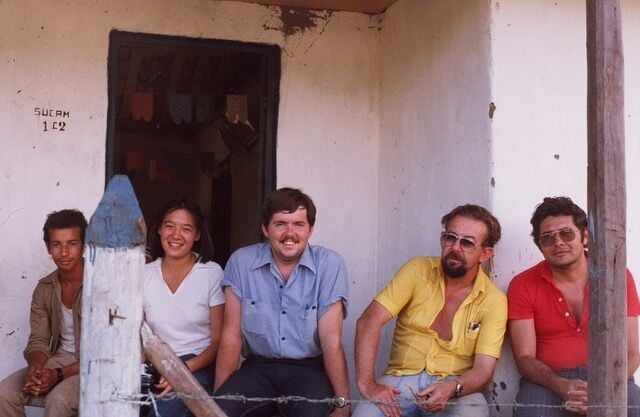
Skillman and his team in Brazil, circa 1980
In fact, when he retired from the Army in 2006, it was as the Deputy Commander of Walter Reed’s Army Institute of Research, which did research on Operation Desert Storm, Operation Iraqi Freedom/Joint Endeavor and Operation Enduring Freedom, to name a few. During his time, he conducted labs worldwide, often coordinating with the CDC, FDA and research groups at Harvard and Cornell, as well as international partners. He coauthored a study along with Dr. Anthony Fauci and 14 other researchers that focused on the role of T cells in HIV infection and AIDS.
“There are tropical infections that most people here have never seen,” Skillman said. “We call them neglected tropical diseases (NTDs) because they receive less funding and research by Big Pharma, so the military does it. People just don’t realize the significant role the U.S. military plays in medical research worldwide, leading to advancements in vaccine and treatment options with global impact, especially with those infections that can pose a threat to where U.S. forces are deployed.”
For example, Skillman described the “ugly skin ulcers” Gulf War soldiers were being infected with. Known as leishmaniasis, it is a parasitic disease transmitted by sandflies and can take weeks or even months to recover from.
“It’s not too bad unless it’s on your face,” Skillman said. “The skin sores are not pretty. And we probably had around 1,000 of our troops who experienced it. But, again, without our research, we wouldn’t know anything about it because it’s not typically found in this country.”

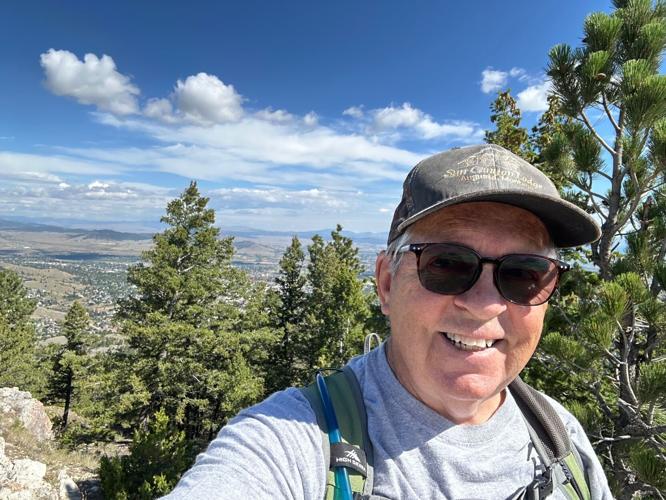
Skillman posing after a hike, circa 2025
Skillman said the Army has also been deeply involved with research and treatment of malaria and dengue fever. While Skillman has never caught malaria, during his time in the various jungles, he has suffered through bouts of both dengue and typhoid fever.
Since he retired, Skillman has made nearly 16 global missionary trips, helping to provide access to healthcare to impoverished populations. He also spends time working as the on-site doctor for an area diabetic camp for kids.
What advice would he give to someone considering the military?
“It’s a great idea,” he said. “It’s an opportunity to travel the world and do great things for the best people in the world. The troops, the war fighters, deserve our utmost admiration and respect. It’s unbelievable the risk they take to protect us.”
Stories of Honor is a series, in partnership with AARP, featuring profiles of 10 veterans across Montana between Memorial Day and Veteran's Day. For more information, please visit states.aarp.org/montana/storiesofhonor.
This content was produced by Brand Ave. Studios. The news and editorial departments had no role in its creation or display. Brand Ave. Studios connects advertisers with a targeted audience through compelling content programs, from concept to production and distribution. For more information contact sales@brandavestudios.com.
In this Series
Stories of Honor
-
Updated
Stories of Honor: Greg Bahny
-
Updated
AARP Stories of Honor: Shelia Stenzel
-
Updated
Stories of Honor: David Lewis
- 18 updates