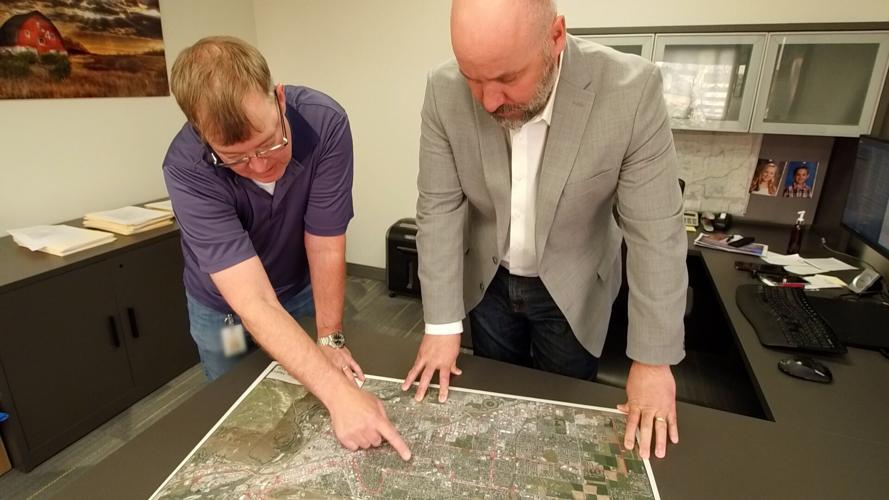

Between semesters at Montana State University, Corey Jensen was preparing to spend the summer on his grandfather’s ranch near the Hi-Line community of Sunburst. A phone call from an acquaintance changed his life in a big way.
The caller said Northern Telephone Cooperative, the member-owned telephone company that served the local area, needed help laying fiber-optic cable. Jensen’s name came up to lend a hand.
“I said I’ll be there tomorrow. I didn’t even ask how much they paid,” said Jensen, who spent five summers staking routes and laying cable. That summer job evolved into full-time post-college employment and served as a springboard that led to Jensen’s current position as Chief Executive Officer of Vision Net, a Montana telecommunications company that operates the state’s largest fiber-optic network.

Corey Jensen, CEO of Vision Net
Helping rural Montana prosper since day one
Vision Net, formed in 1995, is owned by nine Montana rural telephone companies whose owners realized that advanced telecommunications would pave the way for rural Montana to prosper during the 21st century. Vision Net is a company uniquely positioned to deliver a wide range of technical and professional services.
More than a quarter century after its founding, Vision Net provides many products and services, including broadband network transport, internet services, design and management of customized wide area network (WAN) solutions including SD-WAN, and end-point and network security products.
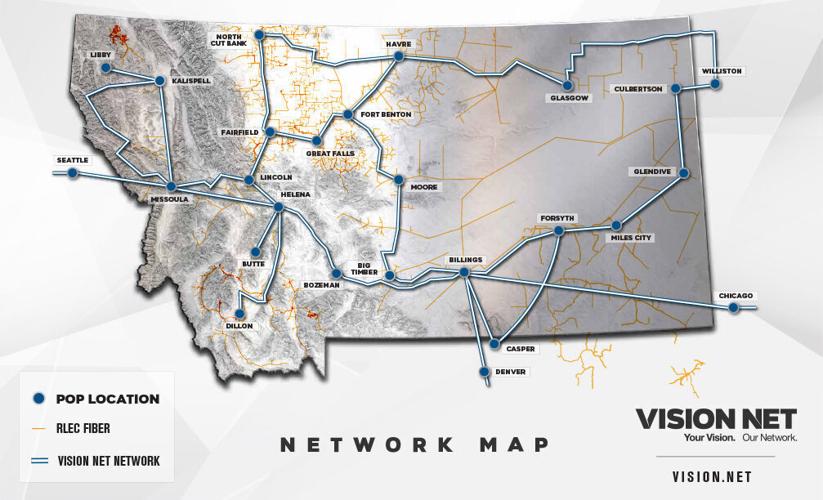
Vision Net’s 5,000-mile fiber-optic network, Montana’s largest, provides telecommunications services to clients such as health care facilities, financial-services institutions, engineering firms and government agencies.
“We can help any business that has multiple locations that need to network together,” Jensen said.
Flexible network solutions for all clients
While some telecommunications companies focus on addressing the needs of either rural or urban clients, Vision Net strives to meet the needs of both. That’s an important consideration in Montana, since many businesses have operations in both larger cities and smaller towns.
One example is Billings-based First Interstate Bank, which operates more than 150 branches across Idaho, Montana, Oregon, South Dakota, Wyoming and Washington.
In 2019 First Interstate selected Vision Net to manage its multi-state, multi-market private network and a backup network. Vision Net replaced a complex system that relied on more than 30 carriers, with a more manageable system with just two carriers.

“As we reviewed the many proposals in front of us, Vision Net immediately stood out for their capability, vast suite of network solutions, and the diversity and flexibility within those systems,” said Kade Peterson, First Interstate’s Chief Information Officer.
Keeping clients connected during the pandemic and beyond
For Vision Net, the pandemic created serious challenges, but opportunities emerged as well.
“From a business perspective, we were in the right place at the right time, and working from home wasn’t a big stretch for us. Our business operates 24 hours a day, 365 days a year,” Jensen said.
“During the lockdown, we could operate remotely and after that, we moved to a hybrid model, securing our employees’ and clients' safety. Now we have most of our employees back to the office while following City-County Health Department protocols” Jensen said.
Traffic on Vision Net’s network has increased 60% over the past year, in part because more people have been working from home.
Today, many businesses have adopted a hybrid model where employees work from home on some days, and in the office on others.
“With this new work environment comes changing needs around mobility, security and identity. Vision Net’s Work Anywhere Suite was designed specifically to reduce distance disparity, support the work model that works best for each individual business and empower employees to be active, engaged, and productive team members, no matter where they are,” Jensen said.
A company that helps other businesses do business
As more companies move critical information to the cloud, Vision Net has developed Vision Secure, a security package that protects clients from cyberattacks. Vision Voice provides a flexible phone system that allows employees to stay connected and gives businesses added mobility for making calls, messaging and conducting online meetings. Vision Connect ensures the client’s connection is stable and performing at its best. Vision Net’s team of experts leverage their knowledge and experience to design a solution that is right for each client’s individual needs and budget.

Looking toward the future, Jensen is spending a lot of time studying how Vision Net will contribute to the Internet of Things, which describes how society is becoming increasingly interconnected through technology. That means automated factories and warehouses are on the horizon, as are driverless cars and even robotic tractors working farmers’ fields.
“People won’t own cars any more. They’ll subscribe to a car service that takes them to the store or to grandma’s house. It’s all fascinating,” Jensen said.
And while no one knows what the next five, 10 or even 25 years will bring, one thing is certain; Vision Net will remain at the forefront of technology, working to keep businesses large and small secure, growing and connected.