
About 16 million men and women served in the U.S. military during World War II. Among them was 26-year-old J. William Smith, an accountant from Billings, who enlisted in the U.S. Army Air Corps to pre-empt the draft.
By the time the war ended in 1945, 17 million combatants had died. Civilian deaths were even greater. At least 19 million Soviet civilians, 10 million Chinese, and 6 million European Jews lost their lives during the war.
The young Smith was likely responsible for some of those deaths. He will never know for sure — and he will never know exactly how many.
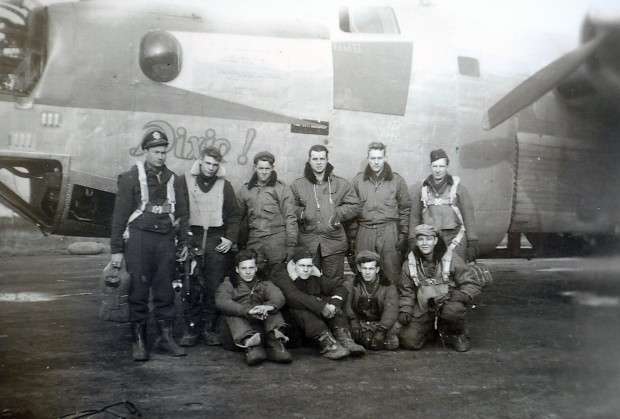
He was a 1st Lt. Bombardier. As such, the ultimate purpose of Smith’s entire B-24 Liberator and crew was accurate and effective bombing.
“Sometimes you couldn’t tell how much damage you did,” Smith said. “I saw the bombs go down and you could see when you busted a bridge. With so many things you just couldn’t tell. You didn’t watch too much. But with the amount of bombs we dropped you could rest assured we did damage every time.”
People are also reading…
The success or failure of the missions depended on what he accomplished in a short interval of the bombing run.
Smith was in absolute command, directing the pilot where to go. He dictated what he wanted done, and until Smith ordered "Bombs away," his word was law.
Under any given set of conditions — ground speed, altitude, direction, etc. — there was only one point in space where a bomb could be released from the airplane to hit a predetermined target. The pressure was on.
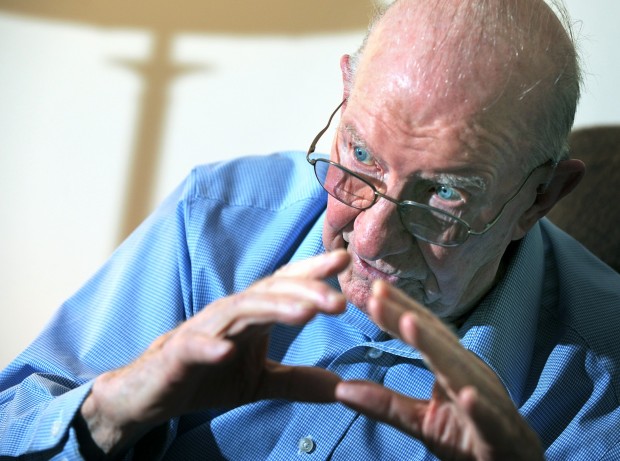
“To tell you the truth, there wasn’t a man who ever did it that wasn’t a little scared but it didn’t keep us from doing our job,” said Smith, now 96 and living in Billings.
Smith, who served from 1943 to 1945, was in the 466th Bomb Group, which was activated on Aug. 1, 1943, and prepared for duty overseas with B-24s. The group moved to England in early 1944 and entered combat on March 22 by participating in a daylight raid on Berlin.
In flying missions, Smith would wake at 4 a.m., eat a quick breakfast then be briefed on the target. They would fly as a squadron at 22,000 feet as the lead bomber would take control, leading them to the target.
“We would salvo the bombs … and head for home,” Smith said.
They encountered some fighter planes and at nearly every target were met with gunfire through the dense, smoke-filled air. Their plane was damaged more often than not. On one mission, his crew’s B-24 lost an engine, leaving them to hobble across Germany alone while losing altitude. They returned safely.
On another mission, he and his crewmates witnessed one of the planes off their right wing explode. One parachute came out with a crew member on fire. All on board perished. The plane had taken a hit and the fuel tanks blew up.
“They were such good friends,” he said, dissolving into tears. “I’ve got a heart that hurts when I think about it.”
The same day one of the gunners on Smith’s crew had his oxygen mask sliced off from flak just in front of his nose.
The 466th operated primarily as a strategic bombardment organization, attacking such targets as marshalling yards at Liege, an airfield at St. Trond, a repair and assembly plant at Reims, an airdrome at Chartres, factories at Brunswick, oil refineries at Bohlen, aircraft plants at Kempten, mineral works at Hamburg, marshalling yards at Saarbrucken, a synthetic oil plant at Misburg, a fuel depot at Dulmen, and aero-engine works at Eisenach.
“The planes blew, too,” Smith said. “Those guys never felt a thing. We just felt, we hoped, we did some damage. We put everything into getting this job done and stopping Hitler and getting this war done.”
In all, he flew 37 missions.
One thing that was a “little tough” on the crews, he said, was the lack of having heated and pressurized cabins. At 22,000 feet, crews were fighting in subzero temperatures. And, without pressurized cabins their ears would plug.
“We’d end up holding our nose and mouth shut and blowing,” he said. “It would generally pop them. I still think it helped us get deaf — before we were very old in some cases.”
Smith said he received numerous bronze and silver Oak Leaf Clusters, but he has stored them and pooh-poohs their importance.
“I haven’t seen ’em since I put ’em away,” he said.
He doesn’t need medals to verify his accomplishments or to substantiate what he did. He knows. That’s what matters.
“I am proud of what we did,” Smith said. “I know we hit a lot of targets. That’s what we were there for. We weren’t there for a joy ride.”
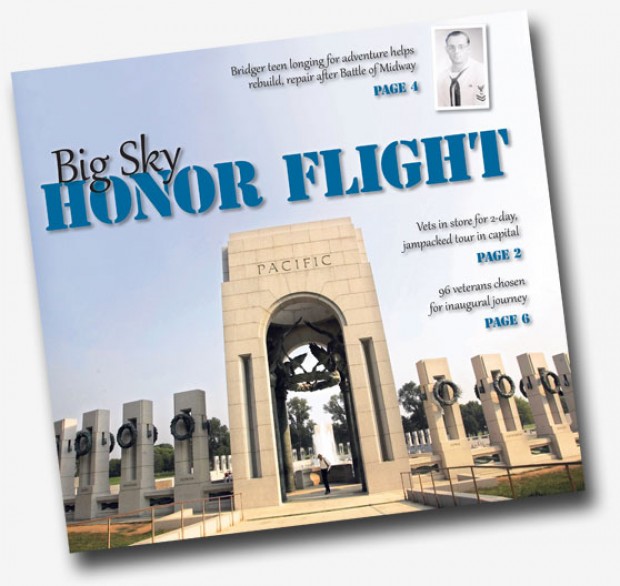
On June 15, Smith, along with 95 other World War II veterans, will take a seat aboard Sun Country Flight 8601 for what this time is sure to be a joy ride. The flight is bound for Washington, D.C., to see the National World War II Memorial. Smith has not seen the memorial and has not been to the nation’s capital since the 1980s.
With barely a whisper, he said, “I’d like to see it.”