


GREAT FALLS - Inside a room in the Neonatal Intensive Care Unit at Benefis Health Care sits a machine that helps save lives, just as they're getting started.
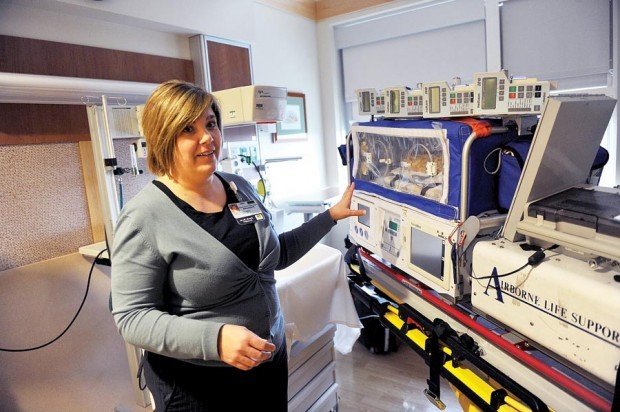
The Isolette - a traveling incubator ready to house a baby born prematurely - waits to be loaded on an aircraft. While it might soon hold a newborn weighing less than 3 pounds, for now the machine rests in a dark room, keeping a bag of caramel popcorn warm.
"It can be a long trip," NICU manager Vicki Birkeland explains of the caramel popcorn. "That's so whoever takes the flight won't get too hungry."
Benefis, the not-for-profit hospital with two campuses in the Electric City, has grown significantly over the last decade. Like the Isolette, the hospital now serves patients and works with rural clinics across 15 counties.
According to officials, roughly 40 percent of the patients in the NICU are transported to the hospital from outside Great Falls. Similarly, people seeking specialized care not available in the small communities that dot north-central Montana, are drawn to Great Falls.
People are also reading…
In a city that has relied on Malmstrom Air Force Base for economic stability in recent decades, Benefis is evidence that Great Falls has diversified its economy far beyond the base.
Patrick Barkey, director of the Bureau of Business and Economic Research at the University of Montana, said that health care is typically viewed as a force in economic growth only if it brings patients and money from outside a community.
"Benefis strikes me as one being a little more effective in expanding its geographic footprint," he said.
***
According to a recent study on Cascade County by the BBER, health care has been a vital economic engine for the region. It represents 14 percent of the county's gross domestic product, according to the U.S. Bureau of Economic Analysis, and in terms of employment is bigger than the military. It also represents a larger share of non-farm earnings (17 percent) than the military (14 percent).
Benefis is a big part of that. With 2,600 employees and a $126.5 million payroll, it accounts for 10 percent of all jobs and labor income in Cascade County and 6 percent of all "new money," which creates 546 new jobs and $18 million in new labor income.
In 2009, Benefis nearly doubled the size of its east campus by completing the South Tower, an $85 million project where the NICU, Women and Children and Heart and Vascular centers are located. The next year, it opened the Orthopedic Center of Montana, a four-story, $17 million facility that was built in partnership with Great Falls Orthopedic Associates.
Finally, in October it opened the $17 million Benefis Medical Professional Center on the hospital campus and has also broken ground on the Grandview at Benefis, Montana's first continuing-care retirement community. A low-income retirement care facility is planned in the future.
That spending is not only a short-term boost for local contractors, it's also a long-term investment in an industry that now draws in more patients than it sends away to out-of-state medical centers.
"The whole medical community here, which is led by Benefis, they've gone from a trade-area leakage, where people were leaving the trade area to get different services - particularly for different specialties - over the last 10 years, and they've been drawing people in," said Brett Doney, president of the Great Falls Development Authority. "It's now a primary sector."
***
That's important in the GFDA's drive to keep the city's economy growing. While Malmstrom has helped keep Great Falls relatively stable, the base has also reduced its work force. In November, the Air Force announced that 45 civilian jobs would be cut from the base. It also might be losing 50 of its intercontinental ballistic missiles.
"(Malmstrom's) helped Great Falls to be very stable, but a number of missions have come and gone," Doney said, adding that the GFDA has helped create the Central Montana Defense Alliance that lobbies for defense missions. "Our strategy is to keep a strong national defense-Homeland Security presence, grow it where we can, but look to diversify the economy."
After removing the 50 missiles, and the 560 jobs that go with them, the Department of Defense ponied up research funds for economic development. Since then, the GFDA has learned to concentrate on expanding areas like energy development, agricultural processing, commercial development and tourism, while limiting health care and retail leakage.
So far, the GFDA has seen success from its efforts. The city remains a hub for energy development with the recent construction of the Rim Rock Wind Farm and is working to add value to its agricultural products. That means seeking projects similar to the state-of-the-art malting plant north of town and the new processing plant for Montana Eggs.
Commercial development has been booming as of late, with the addition of restaurants like Baja Fresh and Canyons Burger, and Café Rio. Meanwhile, tourism should get a big boost as a company in Tennessee has been hired to help Great Falls rebrand itself to draw in visitors.
If it can, perhaps Great Falls could surpass the summer forecast by the BBER, which expected it to grow at a rate of 2.8 percent, 0.5 higher than the state average.
"I think we're going to see continued slow and steady growth," said Steve Malicott, the Great Falls Area Chamber of Commerce president and CEO.
Reporter Jeff Windmueller can be reached at (406) 447-4005 or at jeff.windmueller@helenair.com.


