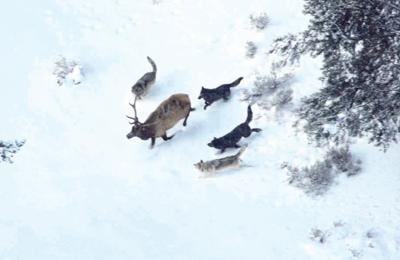

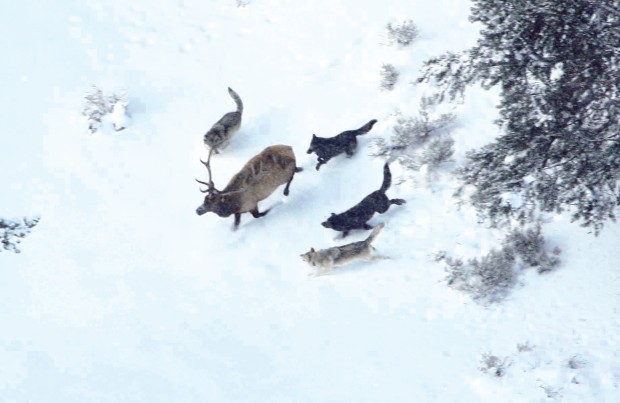
After a dominating 14-year reign in the northwestern corner of Yellowstone National Park, one of the park’s most prolific and most viewed gray wolf packs in the world may have perished.
“The Druid pack is kaput,” said Doug Smith, Yellowstone’s wolf biologist.
It happened quickly.
In January, there were 11 wolves in the pack. But after the alpha female was killed by another pack, the old alpha male wandered off rather than breed with one of the other female wolves that were his offspring. He also suffered from a bad case of mange. Mange is a skin infection caused by a mite that leads to hair loss. In animals with weakened immune systems, it can be fatal. Seven other females in the pack also had mange, and all but one have died from mange or been killed by other packs.
“They’re down to one, and that one probably won’t make it through the winter,” Smith said.
People are also reading…
Gardiner filmmaker Bob Landis, who has based three films on the Druid Peak pack, said its demise marks the end of several productive film years for him.
“They were, for a lot of reasons, easy to film,” he said. “The pack was reasonably tolerable of the road, so there was an opportunity to film at a reasonable distance. Other packs stay in the trees, while these guys were more in the open.”
The pack’s demise comes as regional and national media such as PBS and National Geographic mark the 15-year anniversary of wolves’ reintroduction to Yellowstone from captured Canadian wolves. The five-member Druid Peak pack was established one year later, in April 1996, staking out territory in the Lamar Valley near Soda Butte Creek. The pack’s name came from a nearby landmark.
In the ensuing 14 years, the pack became highly visible to park visitors, researchers, photographers and filmmakers providing groundbreaking insight into wolf interactions. When the animals denned 650 yards from the road, it prompted area closures to prevent traffic problems and human interaction with the animals. It is estimated that more than 100,000 visitors saw the Druid pack.
Top of the heap
The Druids were a pack of firsts.
Only four years after their introduction to the park’s elk-rich environment, the pack expanded to 27 with the birth of 21 pups to three females, making it the largest of eight packs in the park. It was also in 2000 that an alliance of three subordinate females in the Druid pack is believed to have killed the pack’s alpha female, the first such intrapack kill documented in the park.
By 2001, the pack topped out at 37 animals, one of the largest packs ever recorded in North America. The same year, it was also one of two packs to be the first documented killing a grizzly bear cub in Yellowstone.
Such a large pack size was unsustainable, though. By 2002 the pack had broken up, with only 11 animals remaining. Former members created three new packs — the Geode Creek, Agate Creek and Buffalo Fork — while others seemed to bounce from one pack to another. Also in 2002, a male member from the pack was caught in a coyote trap in Mason, Utah, 220 air miles south of the Lamar Valley. After being released back into Wyoming, the wolf walked all the way to Yellowstone to rejoin the Druids.
In 2003, the Druid Pack provided another first when researchers and Landis recorded a six-hour-long ritual song and dance that ended with a new wolf joining the pack as the breeding male. The rites had never been recorded in the wild.
By the end of 2005, the pack had dipped to only four adults after that year’s crop of six pups all died, likely from disease. With few members, the pack was pushed by other wolves to the fringes of its traditional range.
At the time, the pack seemed poised to die off, but rebounded the next year and reclaimed much of its territory.
“It’s quite a story,” said Rick McIntyre, a Yellowstone Wolf Project technician who first saw the wolves when they were still crated before release. He’s not ready to say the pack is gone, though, noting that the alpha male could return along with other dispersed members of the pack.
“I would say they are down and out, but not done yet,” he said.
A state of flux
The loss of packs in the park is nothing new. Since wolves were reintroduced, at least six packs have died off. As packs disappear in the densely populated region of northern Yellowstone, other wolves are quick to make use of the territory. Already, the newly named Silver pack has moved from outside the park into the Druids’ old territory. The four wolves — two adults and two pups — had visited the region before, but never stuck around.
“Now they’re sticking, they’re holding tight,” Smith said.
Three other wolves are also working the same territory, and the female has Druid ties, McIntyre said.
“It’s an example of there’s never a vacant niche very long in nature,” he said. “It fills quickly.”
Contact Brett French at french@billingsgazette.com or at 657-1387.
According to figures released from the Yellowstone Wolf Project, the park’s wolf population is 96-98 wolves; 124 wolves were recorded in 2008. It is the fourth decline since wolf reintroduction began in 1995. A population high of 174 wolves was recorded in 2003.
Population declines in 1999, 2005 and 2008 were associated with the disease distemper. So far there is no evidence that distemper was the cause of the 2009 decline. Probable causes for the decline in 2009 were wolves killing each other, malnutrition and mange.
The greatest decline occurred on the northern range, the area with the greatest wolf density and where park visitors are drawn in hopes of seeing a wolf. Wolf numbers there dropped 29 percent, from 56 to 40 wolves.
The decline in the wolf population in the interior of the park was smaller. Those numbers dipped from 77 to 68 animals, off 11 percent from the previous year.
The number of breeding pairs in the park remained the same at six, the lowest number of breeding pairs recorded since 2000 when wolves first met the minimum population requirement for delisting. A breeding pair is defined as a male and female with two surviving pups. Poor pup survival, due primarily to disease, has kept that number low.