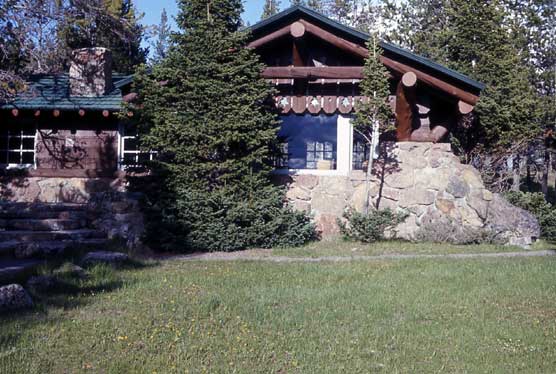
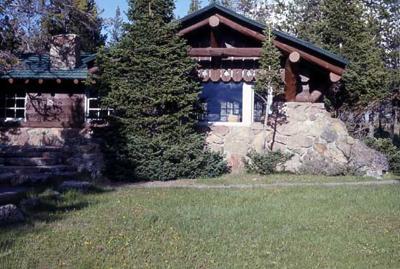
The Madison Information Station dates from 1929-30 and is a
National Historic Landmark. Located at Madison Junction in the
Madison Picnic Area, it is built from wood and stone materials. The
building sits near the site of the legendary campfire circle of the
Washburn-Langford-Doane Expedition. Although no evidence can
confirm the authenticity of this tale, the legend gives us a strong
theme for discussion of the establishment of Yellowstone National
Park. In previous years, this building has been used as a museum,
has housed the Arts Yellowstone program, and has sat empty and
abandoned. It began its new life as an information station and
Yellowstone Association bookstore during the summer of 1995. The
station contains only touch-table exhibits at present, but plans
are underway to design and install orientation panels. A wayside
exhibit just outside the building commemorates the "campfire
story," and a commemorative plaque honors Stephen T. Mather.
This small, nearly dormant basin lies at the top of a very steep
one-mile trail. Thermos-bottle shaped geyser cones are remnants of
a much more active time.
Madison River
The Madison River is formed at the junction of the Gibbon and
Firehole rivers, hence Madison Junction. The Madison joins the
Jefferson and the Gallatin rivers at Three Forks, Montana, to form
the Missouri River. The Madison is a blue-ribbon fly fishing stream
with healthy stocks of brown and rainbow trout and mountain
whitefish.
Terrace Springs
The small thermal area just north of Madison Junction. This area
provides the visitor with a short boardwalk tour of hot
springs.
National Park Mountain
The mountain is actually part of the lava flows that encircle
the Madison Junction area. Near this site, in 1870, the
Washburn-Langford-Doane Expedition is said to have camped and
discussed the future of the region they were exploring. Legend has
it that this was where the idea of the national park was discussed.
It should be noted that there is no evidence of the campfire
conversation ever taking place, and there is certainly no evidence
to show that the idea of a national park was discussed.