



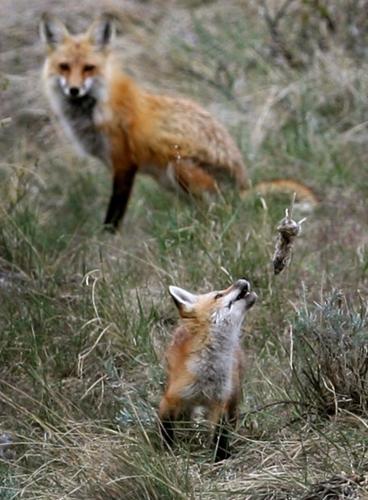
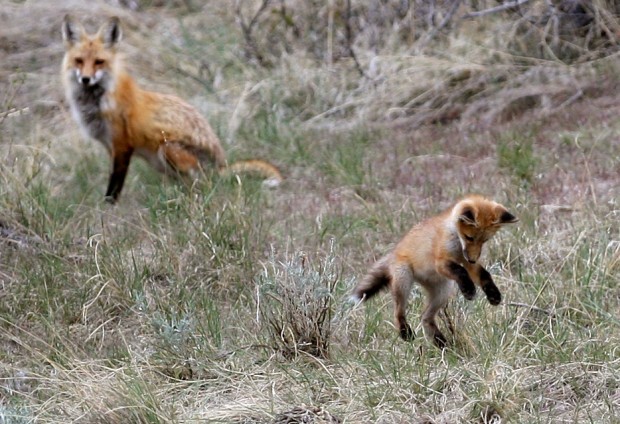
The red fox (Vulpes vulpes) has been documented in Yellowstone since the 1880s. In relation to other canids in the park, red foxes are the smallest. Adult foxes weigh 9–12 pounds; coyotes average 28 pounds in Yellowstone; and adult wolves weigh closer to 100 pounds. Red foxes occur in several color phases, but they are usually distinguished from coyotes by their reddish yellow coat that is somewhat darker on the back and shoulders, with black “socks” on their lower legs. “Cross” phases of the red fox (a dark cross on their shoulders) have been reported a few times in recent years near Canyon and Lamar Valley. Also, a lighter-colored red fox has been seen at higher elevations.
Foxes feed on a wide variety of animal and plant materials. Small mammals such as mice and voles, rabbits, and insects comprise the bulk of their diet. Carrion seems to be an important winter food source in some areas. The many miles of forest edge and extensive semi-open and canyon areas of the park seem to offer suitable habitat and food for foxes. They are widespread throughout the northern part of the park with somewhat patchy distribution elsewhere in the park. Foxes are more abundant than were previously thought in Yellowstone, yet they are not often seen because they are nocturnal, usually forage alone, and travel along edges of meadows and forests. During winter, foxes may increase their activity around dawn and dusk, and even sometimes in broad daylight. In late April and May, when females are nursing kits at their dens, they are sometimes more visible during daylight hours, foraging busily to get enough food for their growing offspring.
People are also reading…
Foxes can become habituated to humans usually due to being fed. One fox in the summer of 1997 was trapped and relocated three times from the Tower Fall parking area because visitors fed it human food. The fox was relocated between 10 and 60 miles away from Tower but twice it returned. Finally the fox came to Mammoth where it was fed again and as a result was destroyed. While this story gives us interesting information about the homing instinct of fox, it also points out the importance of obeying rules to avoid inadvertently causing the death of one of Yellowstone’s animals.
A little known fact about red foxes is mostof them in the lower 48 states, especially inthe eastern and plains states, were introducedfrom Europe in the 18th and 19thcenturies for fox hunts and fur farms. Thefoxes that survived the hunt or escaped the fur farms proliferated and headed westward.In addition to this introduced subspeciesof red fox, three native subspecies existat high elevations in the Sierra (V. v. necatar),Cascade (V. v. cascadensis), and Rocky (V. v. macroura) mountains and are collectivelycalled mountain foxes. (Yellowstone’sfox is V. v. macroura.) Little is known aboutany of these subspecies.
A research project conducted between 1994–1998 determined at least two subpopulations of foxes live in the Greater Yellowstone Ecosystem. At about 7,000 feet in elevation, there seemed to be a dividing line with no geographical barriers separating these foxes. The genetic difference between these foxes was similar to mainland and island populations of foxes in Australia and their habitat use was different as well. In addition, their actual dimensions, such as ear length and hind foot length, were adapted to some degree for colder environments with deep snow and long winters.
Ever since red fox sightings were first recorded in Yellowstone National Park, a novel coat color has been seen at higher elevations. This yellowish or cream color most often occurs above 7,000 feet in areas such as Cooke City and the Beartooth Plateau. Recent genetic analyses are beginning to shed light on this mysterious ‘Yellow fox of the Yellowstone,’ and new evidence is beginning to support the distinctiveness of this high elevation fox.
During the past century, especially within the past few decades, the number of fox sightings has increased greatly. This could be due to better documentation of sightings through the rare animal sighting reports that began in 1986. In addition, an increase in visitors means more chances to see foxes. There may also be a gradual increase in the number of foxes now that the wolf has returned to Yellowstone.
Wolves and coyotes are more closely related both genetically and physically than wolves and foxes, and wolves are successfully competing with coyotes, causing a decline in the coyote population. This may have caused an increase in the number of fox sightings in core wolf areas such as the Lamar Valley.
Recent research shows that red fox are more nocturnal than coyotes, and strongly prefer forested habitats, while coyotes tend to use sagebrush and open meadow areas. In this way, potential competition between fox and coyotes is minimized. Fox don’t seem to actively avoid coyotes during an average day, they just stick with forested habitat, sleep when coyotes are most active, and then forage opportunistically. Fox will visit carcasses (like wolf kills) for the occasional big meal, especially during winter, but this is more rare than the scavenging coyotes that park visitors can expect to see on many days, especially during winter.