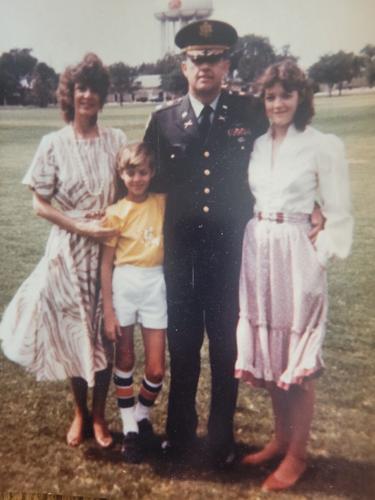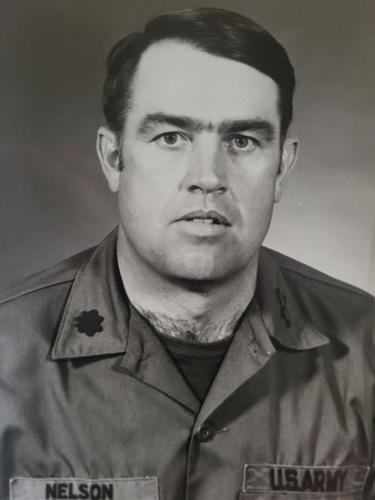

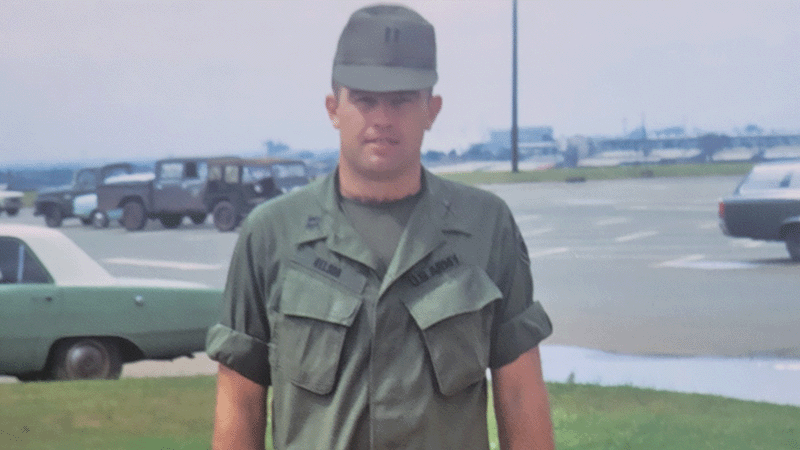
Lt. Col. Harold Nelson
Get it done and get it going.
Words that 21-year Army veteran Harold Nelson lives by.
“I was in a position of leadership, and when you are in that position, you have to take care of your troops and make sure everything is moving along — that you are doing the right thing and that people are being taken care of,” said Nelson, 85.
Before retiring as a lieutenant colonel, Nelson served two tours in Germany (1963-66, 1976-80) with the 28th Field Artillery Regiment and two in Vietnam (1966-67, 1970-71) with the 35th Field Artillery Regiment, serving as battery commander, aerial observer and in operations. Between deployments from his base at Fort Sill (Lawton, Oklahoma), he earned his master’s degree in business from the University of Georgia (Athens, Georgia).

His first tour of Vietnam (Xuan Loc) in 1966 came on the heels of his first deployment to Germany. He said the war was just getting started in Vietnam and he was involved in a lot of combat operations. During one excursion, a mortar landed right next to him and a piece of shrapnel pierced his scalp.
“They dug it out, and I was fine, and I was sent right back into combat,” Nelson said. “Others were not so lucky. Some were killed.”
When pressed for more details of the injury, Nelson was quick to say, “It was not a big deal.”
Get it done and get it going.
As Nelson said, “Take care of the people around you and do your job. Do it well.”
He received a Purple Heart for his injury.
In 1970, when he returned to Vietnam and was stationed in Da Nang. He served in an operational capacity at Army headquarters and did not see a lot of direct combat.
Nelson noted the difference in how he and other troops were treated upon their return stateside from Vietnam.
“After my first tour, if you were at the airport with your uniform on, people would almost spit on you,” Nelson said. “There were a lot of protests against the war. I mean, if people want to protest, that’s fine. But what they didn’t get is that we were just doing what we were told. We were in the military. The reaction after the second tour was a little better. People nowadays really understand that you are sacrificing things when you go somewhere, so it’s very different.”
When his second deployment to Vietnam ended in 1971, Nelson attended the U.S. Army Command and General Staff College at Fort Leavenworth, Kansas, the graduate-level military education institution for U.S. and allied field-grade officers. He returned to Fort Sill and served as a lieutenant colonel until 1976, before being deployed for his second tour of Germany (17th Field Artillery Brigade), where he stayed for four years. In 1980, he returned to Fort Sill and served as the Command Battalion Leader (2nd Battalion Field Artillery Regiment) before retiring four years later and moving to Missoula.

Not one to waste words or dwell on his time in the military, Nelson admits that he doesn’t like to be “wishy-washy. I just want to get it done and get it going. I always want to be on time and I like things to be direct.”
Perhaps that’s why he had no regrets retiring and moving on.
“Right before my retirement, I knew I was on the list to be a colonel and my next assignment would have been to D.C.,” he said. “I had two kids, one in high school and the other in middle school and I just didn’t think it would be a good thing for them to move again. I was born and raised on a farm in Stevensville and I just thought I would retire, move to Montana, and that it would be better for the family.”
Upon his return, he and his brother founded Big Sky Mobile Catering Corporation, which provides mobile kitchens for emergency disaster relief and wildland fires, remote construction and large-scale events throughout the United States. In business for more than three decades, Nelson said the company has fed up to 2,000 emergency personnel three meals per day in some of the country’s hardest-hit disaster zones. The meals are made in fully self-contained, portable kitchens that include 12 semi and four box trucks, spread over four teams.
He joked that while he was not the chef in the Big Sky kitchens, he served as the “overseer, just like a commander in the military.”
Today, his family is still involved with the company.
Stories of Honor is a series sponsored by AARP that profiles veterans living across Montana. Visit aarp.org/storiesofhonor for more information.
This content was produced by Brand Ave. Studios. The news and editorial departments had no role in its creation or display. Brand Ave. Studios connects advertisers with a targeted audience through compelling content programs, from concept to production and distribution. For more information contact sales@brandavestudios.com.
In this Series
Stories of Honor
-
Updated
Stories of Honor: Mike Higgins
-
Updated
AARP Stories of Honor: Dallas Knight
-
Updated
Stories of Honor: Greg Bahny
- 20 updates