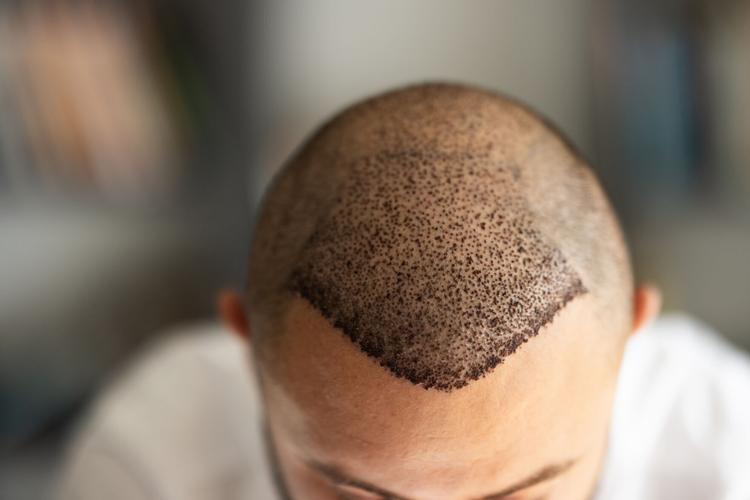


Top view of scalp after hair transplant surgery
The first few days after a hair transplant tend to feel like a turning point. The hairline is finally where it should be, the recipient area is dense with new grafts, and after years of watching hair disappear, something has been put back. Many patients take photographs in those first days and look at them more often than they would admit.
Then, somewhere between the second and eighth week, the mirror starts telling a different story. The newly transplanted hairs fall out. The shaved donor area is growing back unevenly. In some cases, the native hair around the recipient zone thins as well. For a period that can last months, patients who paid, traveled and waited for this procedure can look worse than they did before it.
This phase is expected, well described and almost always temporary. It is also one of the least discussed parts of the process, and the gap between what patients are told and what they experience is where most of the distress comes from.
People are also reading…
The Timeline Nobody Feels Prepared For
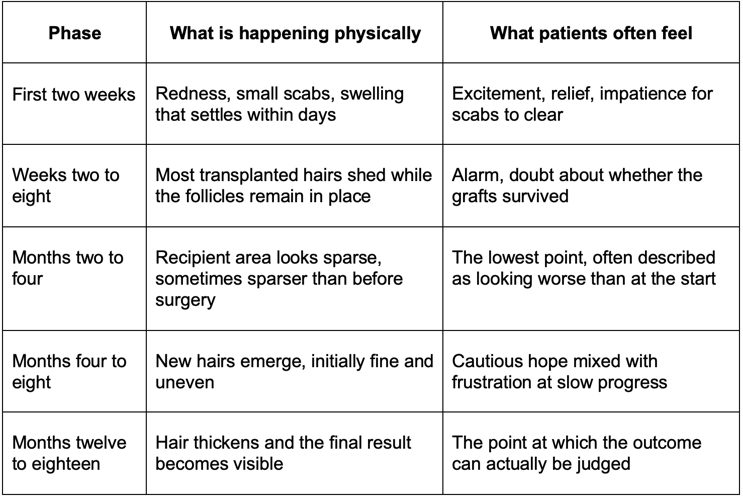
The recovery after a follicular unit extraction procedure follows a broadly predictable sequence, although the exact timing varies between individuals.

The difficult stretch sits in the middle of that sequence, well after the patient has returned home and long before anything resembling the result has appeared.
Why the Transplanted Hair Falls Out
The shedding that follows a transplant is the single most common source of anxiety, and it is also the most straightforward to explain. Moving a follicle from the back of the scalp to the front is a significant stress for that follicle. Most respond by entering a resting phase and releasing the hair shaft they were carrying.
What falls out is the visible hair. What stays behind is the follicle, anchored in its new position and preparing to produce a new hair once the resting phase ends. Patients who notice small hairs on their pillow or in the shower in the weeks after surgery are seeing this process, not a failed operation.
Knowing that in advance does not make the experience pleasant. It does change how it is interpreted, which turns out to matter a great deal.
When Native Hair Sheds Too
A second and less predictable form of shedding can affect the patient’s existing hair around the recipient area. Known as shock loss, it is a temporary effluvium triggered by the surgical trauma to surrounding tissue.
Okochi and colleagues examined 621 patients who underwent follicular unit extraction at a single center and published their findings in Aesthetic Plastic Surgery in 2023. Shock loss occurred in 23 of them, roughly 3.7 percent overall. The distribution was striking. It affected 9 of 554 men, around 1.6 percent, compared with 14 of 67 women, around 21 percent, and the authors identified sex as the main risk factor. Among women, older age increased the risk further.
A review of complications after follicular unit excision by Romera de Blas and colleagues, published in Frontiers in Medicine in 2026, lists effluvium among recognized recipient site events and identifies careful patient selection, refined surgical technique and standardized postoperative care as the main ways to reduce complications.
For most patients, and particularly for men, shock loss is uncommon. For women, it is common enough that it should be discussed explicitly before any procedure. In both groups, affected native hair usually recovers, though the months in which the transplanted and existing hair are both shedding can be the hardest of the whole process.
Why the Dip Hits So Hard
The physical explanation is only half of the story. The other half is the situation in which patients experience it.
By the time the shedding begins, the decision has been made, the money has been spent and, for international patients, the clinic is a flight away. Many have told friends or family about the procedure. Some were motivated precisely by how much their hair loss had been affecting them, which means the temporary return of thinning lands on the most sensitive possible ground.
Rebora, writing in Clinical, Cosmetic and Investigational Dermatology in 2019, noted in a review of telogen effluvium that excessive shedding can have a profound effect on a patient’s state of mind, and that a common error among clinicians is to minimize the complaint. That observation applies with extra force after a transplant, when the patient has deliberately paid for more hair and is watching hair leave instead.
Expectation can compound the effect. Before and after galleries typically show a result at twelve months or later. The months in between are rarely photographed, rarely posted and rarely discussed, so patients may measure their own month three against someone else’s month twelve.
What the Research Says About the Other Side
The encouraging part of the evidence concerns what happens once the dip has passed.
Maletic and colleagues followed 48 patients with androgenetic alopecia through follicular unit extraction across two centers and reported their results in Aesthetic Plastic Surgery in 2023. Physical and mental components of quality of life improved significantly after surgery, life satisfaction rose, and measures of stress and anxiety fell. Liu and colleagues tracked 1,106 men through hair transplantation for the Journal of Cosmetic Dermatology in 2018 and found clear gains in self-esteem and satisfaction with appearance at nine months.
The same studies carry a caution. In the Maletic data, the depression measure did not change. In the Liu data, patients who entered surgery with low self-esteem were less satisfied afterward than those who did not. A transplant can ease worry about appearance once the result has grown in. It does not resolve difficulties that sit deeper than hair, and patients carrying those difficulties may find the temporary dip especially hard.
Who Tends to Struggle Most
The patients who find the recovery period hardest tend to share a few characteristics. They may not have been given a clear, written timeline before surgery. They may have expected visible improvement within weeks rather than months. They may measure progress daily in a mirror rather than monthly in photographs taken under the same conditions. They may lose contact with the clinic once they are home. And for some, the procedure was carrying hopes that reached well beyond their hairline.
Women face an additional layer of uncertainty because of their higher risk of shock loss, which can make preoperative counseling particularly important for them.
What Helps Patients Through It
Much of the distress in this phase can be reduced before surgery ever takes place. A patient who has been shown the full timeline, including photographs of the difficult months, interprets shedding as a stage rather than a failure.
After surgery, a few habits help. Photographs taken once a month in the same place, at the same angle and under the same light may show progress that daily mirror checks conceal. Comparing one’s own month four with someone else’s month four is more useful than comparing it with a final result. Medical treatment for the native hair, where appropriate, may protect the areas around the transplant while the new hair grows in.
Continued contact with the operating team is perhaps the most important factor. A clinic that reviews progress photographs at regular intervals through the first year can reassure a patient when the process is on track and act early when it is not. Anyone comparing options for a hair transplant in Turkey should ask how that follow-up works in practice and who reviews the photographs.
“Month three is when we hear from patients most, usually with one photograph and one question, which is whether it worked. That is why we ask for the same photograph every month for a year. The answer is in the comparison, not in the mirror on a bad day,” said Dr. Mehmet Erdoğan, co-founder of Smile Hair Clinic in Istanbul.
That follow-up is also worth checking in the price itself. Postoperative care is the item most often missing from a low quote, and a clear breakdown of hair transplant cost should state how long the clinic stays involved after the patient flies home.
If low mood persists well beyond the expected dip, or begins to affect sleep, work or relationships, it is worth speaking to your doctor or a mental health professional rather than waiting for the hair to resolve it.
Judging the Result at the Right Moment
The weeks after a hair transplant ask patients to trust a process they cannot see. Hair that was just placed falls out, native hair may thin, and the mirror offers little evidence that anything worthwhile has happened.
That dip is not a sign of failure. It is a predictable part of how transplanted follicles behave, and for most patients it gives way to the improvement in appearance and well-being that the research consistently measures. The patients who come through it best are rarely the most patient by nature. They are the ones who knew exactly what the difficult months would look like before they began.