


MSU Billings students take to the phones to gather Montanans’ view of the current political landscape.
MSU BILLINGS NEWS — Lab work at Montana State University Billings does not always involve microscopes. Sometimes taking a closer look involves a few thousand phone calls and the kindness of strangers.
Students in Dr. Hope Dewell Gentry’s Political Science 342 class at MSU Billings this fall are going about the annual work of gauging public opinion. The course, “Media, Public Opinion, Polling,” is taught each fall semester by Dewell Gentry, an assistant professor of Political Science in the Department of Social Sciences and Cultural Studies.
The class gives students an academic understanding of the intersection of public opinion and political science because they go from reading about it to actually doing it. It is a chance to show determination as well as an exercise in following stringent requirements, so their final product has a high level of confidence on accuracy.
People are also reading…
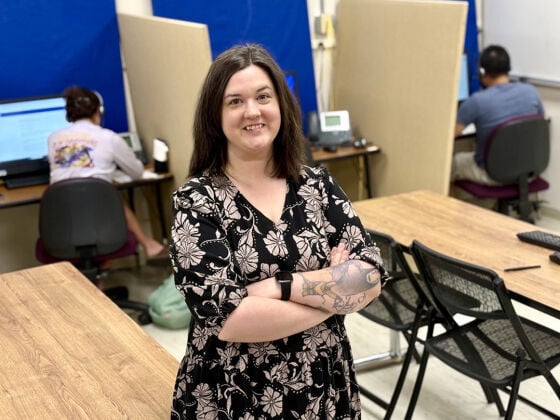
The students in this fall’s section have been spending time at a six-booth telephone bank in the Liberal Arts building for the past week using a random digit dialing system that pulls from a list of about 7,000 Montana phone numbers as part of the Mountain States Poll. The poll has been a staple of MSU Billings’ political science program for years and has students at the center of the process. Students write the questions, make calls and analyze the data.
“It really is a perseverance exercise,” Dewell Gentry said.
When students get through to someone who answers and they get a chance to explain they are doing the poll for a class, people are generally understanding, Dewell Gentry said. The challenge these days, she said, is dealing with AI-generated voice message guardrails.
“There’s a decline in people actually answering their phones because of AI filtering systems,” she said. “It’s a national problem.”
Students work in shifts of one or two hours, calling numbers randomly generated by a computer program and providing completed answers to a database housed at the university. There are 30 questions that inquire about views on job performance of federal officials, Montana’s congressional delegation, state elected officials and a variety of other national and state issues.
Some of the students in this year’s class have experience with government operations and political races, ranging from hometown school board campaigns to doing internships. But this “lab work” marks total immersion in a nonpartisan project.
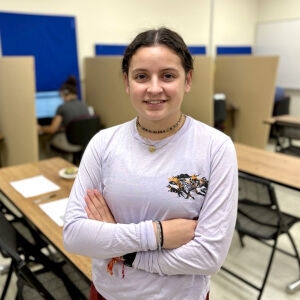
Sarah Eichmann, a 19-year-old sophomore from Colorado, has had experience doing campaign work for a candidate in her hometown. She said she has been getting some friendly responses from those being called on the random dialing system and appreciates the honesty of those who actually answer the phone.
“It’s interesting to do this all in an unbiased way,” Eichmann said. “It’s a good experience. We had an anarchist answer the phone yesterday.”
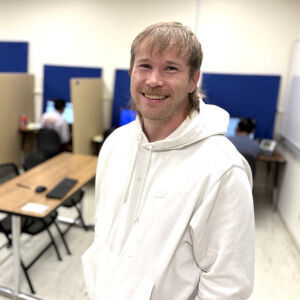
Gavan Myers, a 32-year-old senior from Absarokee, has had on-the-ground experience working for former Congressman Denny Rehberg and former Superintendent of Public Instruction Elsie Arntzen. But this fall is his first in-depth polling experience.
And, Myers said, the real difference is in dealing with the prevalence of artificial intelligence call screeners.
“AI taking over voicemail is really different,” he said. “I don’t get as many angry hang-ups, but it’s tough getting past the AI gate.”
Dr. Craig Wilson conducted the first version of the Mountain States Poll in 1989. It was first called the Eastern Montana College Poll and then the Montana Poll. The survey was renamed the Mountain States Poll in 2019. This year’s poll will be the 39th edition, with some years having multiple polls.
For this year’s poll, data will be gathered through Wednesday, Oct. 14, and students will announce the results on Oct. 27.


