


MSU Billings students conduct 39th Mountain State Poll
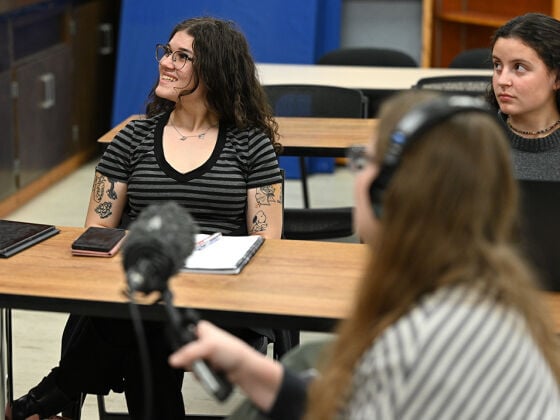
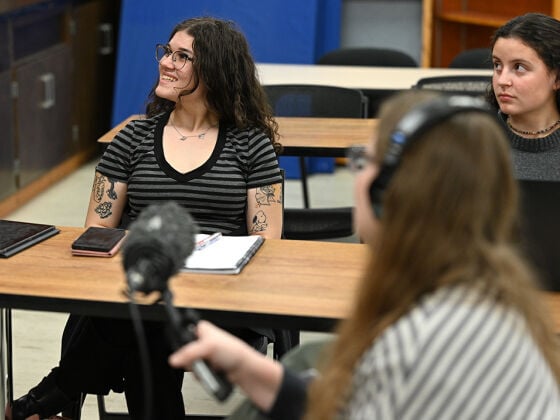
MSU Billings political science students gather opinions for the 39th rendition of the Mountain State Poll.
MSU BILLINGS NEWS – Montanans are not only giving low marks to their elected officials, they tend to support putting limits on them. And, as if to further demonstrate displeasure with polarization, Montanans say they prefer thinking for themselves when it comes to deciding issues.
Those are some of the insights gleaned from responses gathered this month for the 39th edition of the Mountain State Poll conducted by political science students at Montana State University Billings.
“When it came to the question about alignment with political parties, I expected people to say they always supported their political parties, but that didn’t end up being the case,” said Kaleb David, a senior at MSU Billings whose political science class conducted the annual poll.
People are also reading…
David and fellow students were at a class presentation and media conference on Tuesday to announce the results of the current poll.
The class, “Media, Public Opinion, Polling” is taught each fall semester by Dr. Hope Dewell Gentry, an assistant professor of political science in the Department of Social Sciences and Cultural Studies at MSU Billings. The class not only gives students academic understanding of the intersection of public opinion and political science, but it immerses them in it.
Through online surveys and random phone calls made from a list of 7,000 Montana phone numbers provided by Scientific Telephone Samples, the seven students in the class recorded 750 responses collected from Oct. 5-21. There was a margin of error of 3.65 percent.
Low approval for Congress and interest in limits
Many of the 27 questions in the most current poll showed the usual splits on issues and viewpoints between Republicans, Democrats and independents. Montana voters this year showed unity for the response on one question: “At this point in time, do you approve or disapprove of the performance of the U.S. Congress?”
With an 8 percent approval rating, the dissatisfaction even surprised Dewell Gentry.
“Congress tends to be the least popular of the three branches, as we’ve seen in the past,” she said. “With that said, this is pretty low.”
The survey showed that only 3 percent of respondents who identified themselves as Democrats, 18 percent of those who identified themselves as Republicans, and 4 percent of independents had a favorable view of Congress. The feeling cut across age and education breakdowns, the survey showed.
In addition, a clear majority of those surveyed said they wanted to keep more control over Congress. The results showed 85 percent of the survey respondents said they disapproved of members of Congress being able to give themselves a raise, and 84 percent said they disapproved of Congress using insider trading strategies.
Views on Montana leaders and party loyalty
And while approval rates of Montana Gov. Greg Gianforte, U.S. Sen. Steve Daines and U.S. Sen. Tim Sheehy were split along party lines, the notion of wholesale support of political parties has limits.
When asked if they “were likely to support your political party regardless of the political issue, or that your support of the party depends on the issue,” 52 percent of the poll respondents said support was issue dependent. That sentiment was virtually the same among Republicans (55 percent), Democrats (54 percent), and independents (51 percent).
Opinions on technology and foreign policy
Among other findings in the poll:
- 65 percent of survey respondents disapproved of data centers being built in Montana.
- 30 percent of respondents said they use Artificial Intelligence (AI) only occasionally, with 26 percent saying rarely, 22 percent saying never, and 19 percent saying often.
- 55 percent disapprove of the U.S. military action in Iran.
- 40 percent disapprove of continued U.S. support to Israel militarily and economically.
Student experience and polling challenges
Students worked in shifts of one or two hours, calling numbers randomly generated by a computer program and providing completed answers to a database housed at the university. When students were able to get someone on the other end of the phone to answer, they enjoyed the conversation, said Lynnzie Watson, a junior originally from Texas. The conversations with strangers were a welcome break from normal text or email conversations for students, she said.
“That’s stuff we really don’t get to do much,” she said.
But with the advent of AI tools that allow people to block more calls, getting answers is more difficult. And it limits the completion rate that can be obtained via a random-dialing polling system.
Dewell Gentry said the completion rate — already challenging in an increasingly insular country — went from 2 percent per student per hour last year to 1 percent per student per hour this year. That challenge will be a topic she plans to address in the coming years of the survey.
Results of the current poll and archived results dating back to 1999 can be found on the MSU Billings website.


